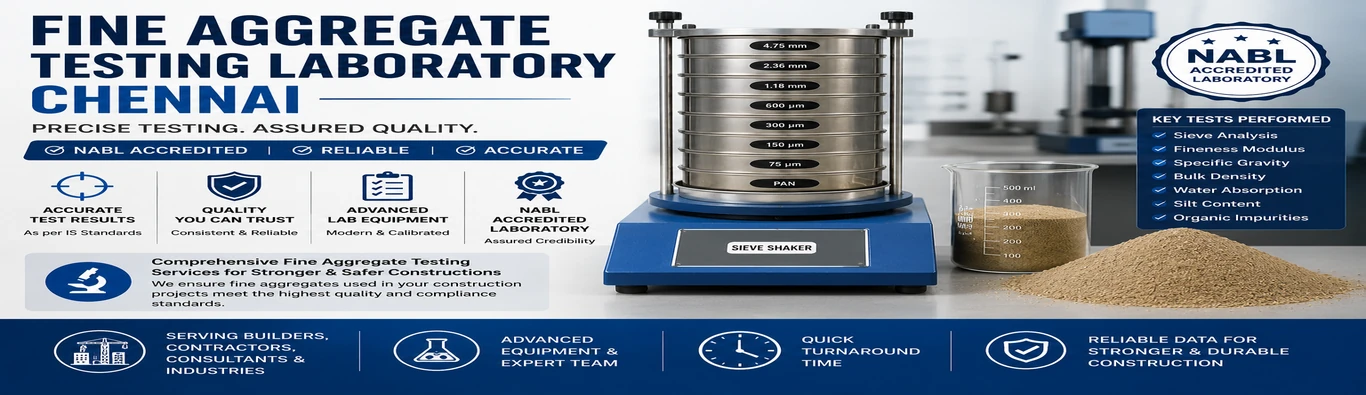
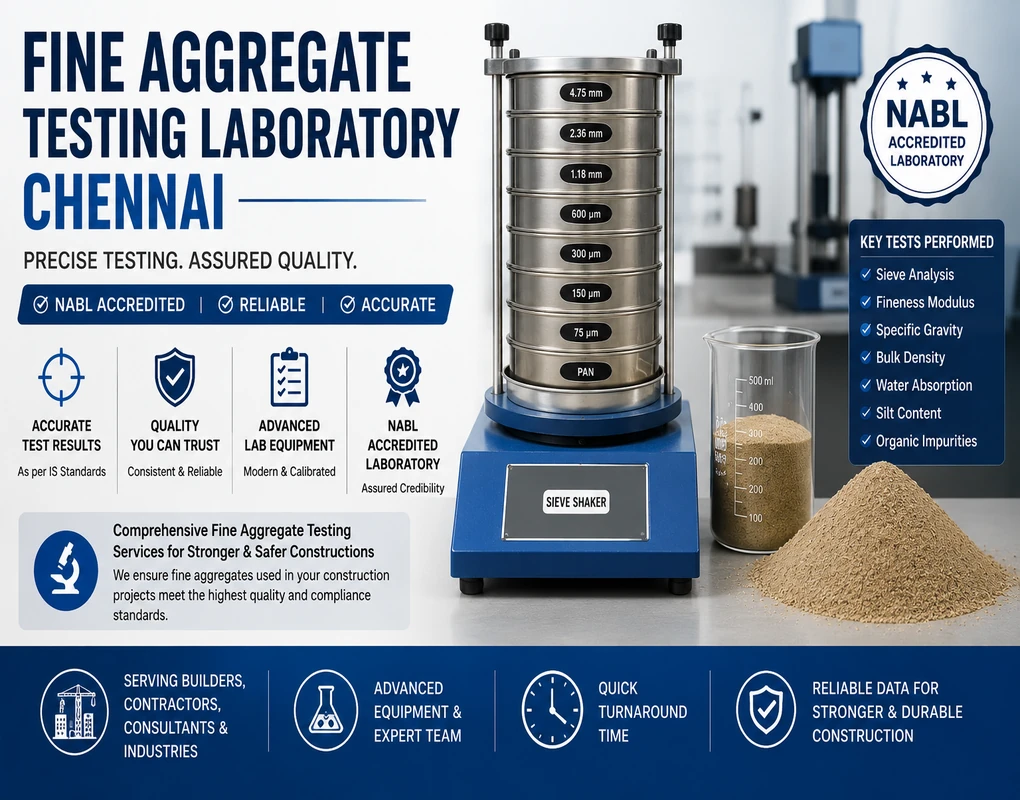

HiTech Concrete Solutions Chennai Pvt. Ltd. is a trusted Fine Aggregate Testing Laboratory in Chennai providing comprehensive testing services to evaluate the quality, strength, cleanliness, and suitability of fine aggregates (sand) used in construction. As a NABL Accredited Laboratory in Chennai, we perform accurate laboratory testing in accordance with BIS (IS) standards to ensure superior construction quality and long-lasting structural performance.
Whether you are searching for Construction Testing Services Near Me, Material Testing Lab Chennai, or a reliable Construction Material Testing Laboratory Chennai, our experienced engineers deliver precise fine aggregate testing services for residential, commercial, industrial, and infrastructure projects throughout Chennai and Tamil Nadu.
Fine aggregate plays a critical role in concrete strength, mortar quality, and durability. Our advanced testing methods help identify impurities, grading, moisture, density, and other important characteristics before construction begins.
Determines the particle size distribution of fine aggregates to ensure proper grading for concrete and mortar production.
Measures the density of fine aggregate to evaluate its quality and suitability for concrete mix design.
Determines the water absorption capacity of fine aggregate, helping engineers calculate the correct water-cement ratio.
Measures the bulk density of fine aggregates to estimate material quantity and optimize concrete mix proportions.
Determines the loose bulk density of sand without compaction, supporting accurate material calculations.
Measures compacted bulk density using standard rodding procedures to determine aggregate packing characteristics.
Evaluates the percentage of silt and fine particles present in sand that may affect concrete strength and bonding.
Determines the increase in sand volume caused by moisture, helping maintain accurate batching during concrete production.
Measures the moisture present in fine aggregates to achieve accurate water-cement ratios and consistent concrete quality.
Assesses the resistance of fine aggregates to weathering and repeated environmental exposure, ensuring long-term durability.
Evaluates the potential chemical reaction between aggregates and cement alkalis to prevent expansion and concrete cracking.
Identifies harmful materials such as clay lumps, coal particles, shale, and organic contaminants that may reduce concrete quality.
Detects the presence of organic matter that can adversely affect cement hydration and concrete strength.
Measures chloride and sulphate content in aggregates to minimize reinforcement corrosion and chemical deterioration of concrete structures.
