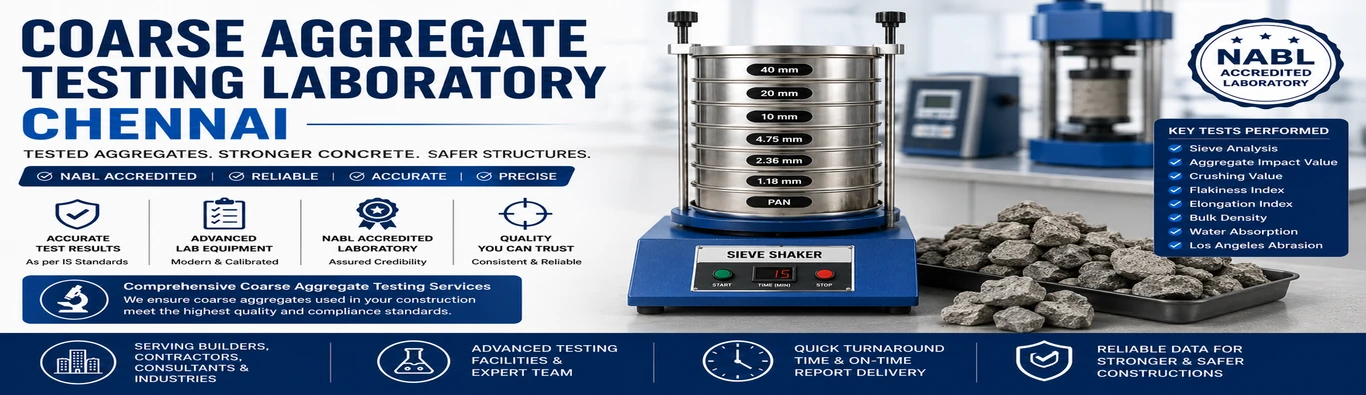
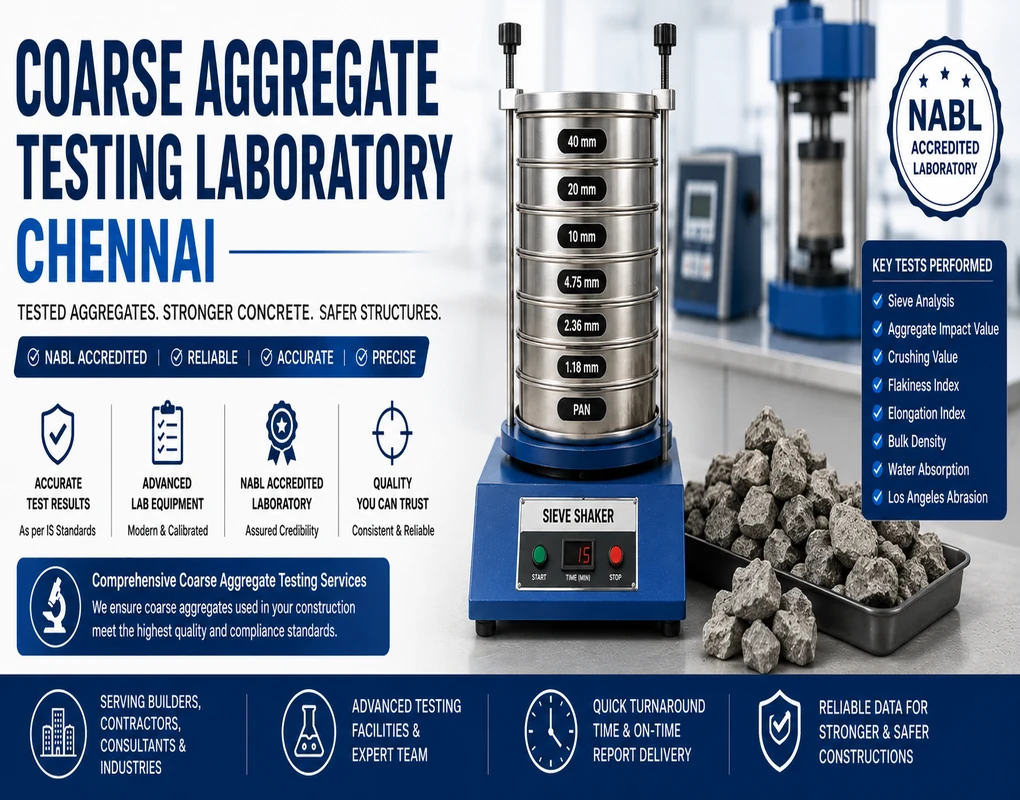

HiTech Concrete Solutions Chennai Pvt. Ltd. is a leading Coarse Aggregate Testing Laboratory in Chennai, offering accurate and reliable testing services for crushed stone, gravel, and coarse aggregates used in residential, commercial, industrial, and infrastructure projects. As a NABL Accredited Laboratory in Chennai, we perform comprehensive aggregate testing in accordance with BIS (IS) standards to ensure superior construction quality, durability, and structural performance.
Whether you are searching for Construction Testing Services Near Me, Material Testing Lab Chennai, or a trusted Construction Material Testing Laboratory Chennai, our experienced engineers provide advanced testing solutions that help builders, contractors, consultants, and government organizations achieve safe and durable construction.
Determines the particle size distribution of coarse aggregates to ensure proper grading for concrete production and structural stability.
Measures the density and quality of coarse aggregates used in concrete mix design.
Evaluates the water absorption capacity of aggregates, helping determine durability and appropriate mix proportions.
Measures the bulk density of aggregates for accurate quantity estimation and concrete mix calculations.
Determines the loose bulk density of coarse aggregates before compaction.
Measures compacted bulk density using standard rodding procedures to determine packing characteristics.
Determines the toughness of aggregates and their resistance to sudden impact loads used in roads, pavements, and structural concrete.
Measures the resistance of aggregates to crushing under gradually applied compressive loads, ensuring structural strength.
Evaluates the force required to produce 10% fines from aggregates, providing an alternative assessment of aggregate strength.
Determines the moisture present in coarse aggregates to maintain accurate water-cement ratios during concrete production.
Measures the resistance of aggregates to wear and abrasion, ensuring long-term durability for roads, highways, and heavy-duty pavements.
Assesses the resistance of aggregates to weathering, freeze-thaw cycles, and environmental deterioration.
Determines the potential chemical reaction between aggregates and cement alkalis that may cause expansion and cracking.
Detects harmful materials such as clay lumps, shale, coal, soft particles, and other impurities that reduce concrete quality.
Evaluates the presence of organic contaminants that may interfere with cement hydration and concrete strength.
Measures chloride and sulphate content to minimize reinforcement corrosion and chemical deterioration in reinforced concrete structures.
